AI-search considerations appeared in 47% of records
Seventeen of the 36 records connected content strategy with AI search, GEO, AEO, LLM discovery or citation visibility.
Research Note 01 September 2026
A data-led analysis of 36 coded source records and survey responses from 723 senior content leaders in the UK and US.
Research & analysis by
Deepshikha Dhankhar
The executive read
The research points to a harder problem: deciding what deserves to exist, grounding it in evidence, making it discoverable across search and AI surfaces, and proving that it changed a business outcome.
This report maps the shift from content generation towards systems, control and traceable strategic decisions.
The first phase was generation. The next phase is control.
Finding 01
Across the coded records, content strategy extends beyond production into architecture, retrieval, governance, distribution and evaluation.
Seventeen of the 36 records connected content strategy with AI search, GEO, AEO, LLM discovery or citation visibility.
Thirteen records described topic clusters, structured knowledge, internal-linking networks, persistent context, reusable components, refresh cycles or quality gates.
Finding 02
The reviewed products compete heavily on how much content work they can accelerate or combine in one environment.
Eight records combined functions such as ideation, keyword research, briefs, writing, visuals, publishing and analytics.
The framework records associated reliability with bounded tasks, persistent context, inspectable hand-offs, stop conditions and human escalation.
Finding 03
The corpus contains extensive support for creation, but less consistent coverage of the decisions, controls and measurement surrounding it.
Fewer records showed how a recommendation traces back to customer signals, product relevance and approved evidence—or how a proposed asset is tested before creation.
Refresh, consolidation and retirement were less visible than net-new creation. Rankings, AI citations, reviews, community presence and pipeline were also commonly measured in separate workflows.
Finding 04
Different teams require different levels of governance, but the underlying need is consistent: a defensible route from evidence to action.
Enterprise-oriented records placed the greatest emphasis on permissions, approved source truth, auditability and cross-team consistency.
Agency and consulting records combined pressure for repeatable delivery with a need to show clients how recommendations were reached.
For smaller teams, limited time and attention made prioritisation more relevant than enterprise-scale workflow depth.
Finding 05
AI is changing collaboration, budgets, career intent and performance priorities faster than it is building confidence.
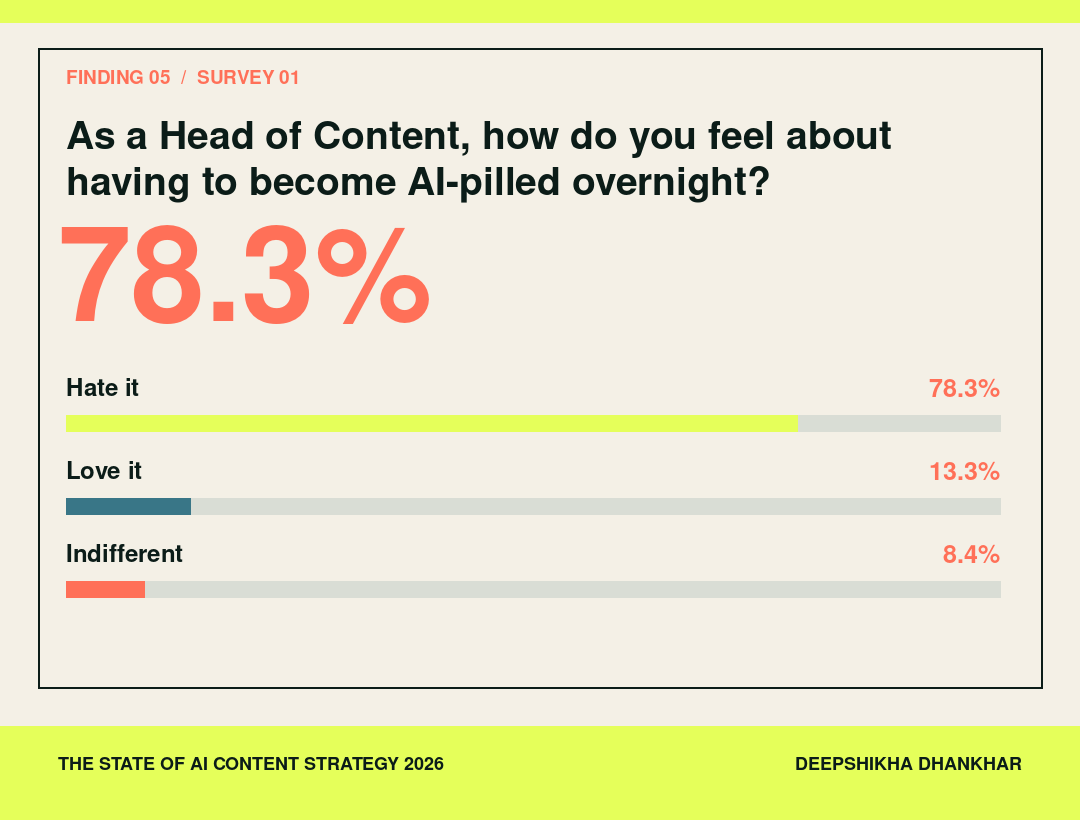
78.3% selected ‘Hate it’, compared with 13.3% who selected ‘Love it’ and 8.4% who selected ‘Indifferent’. This indicates that adoption expectations are moving faster than workforce readiness. Content and SEO teams need staged training and clearer role boundaries now; without them, transition pressure may weaken retention and the quality of strategic decisions over time.
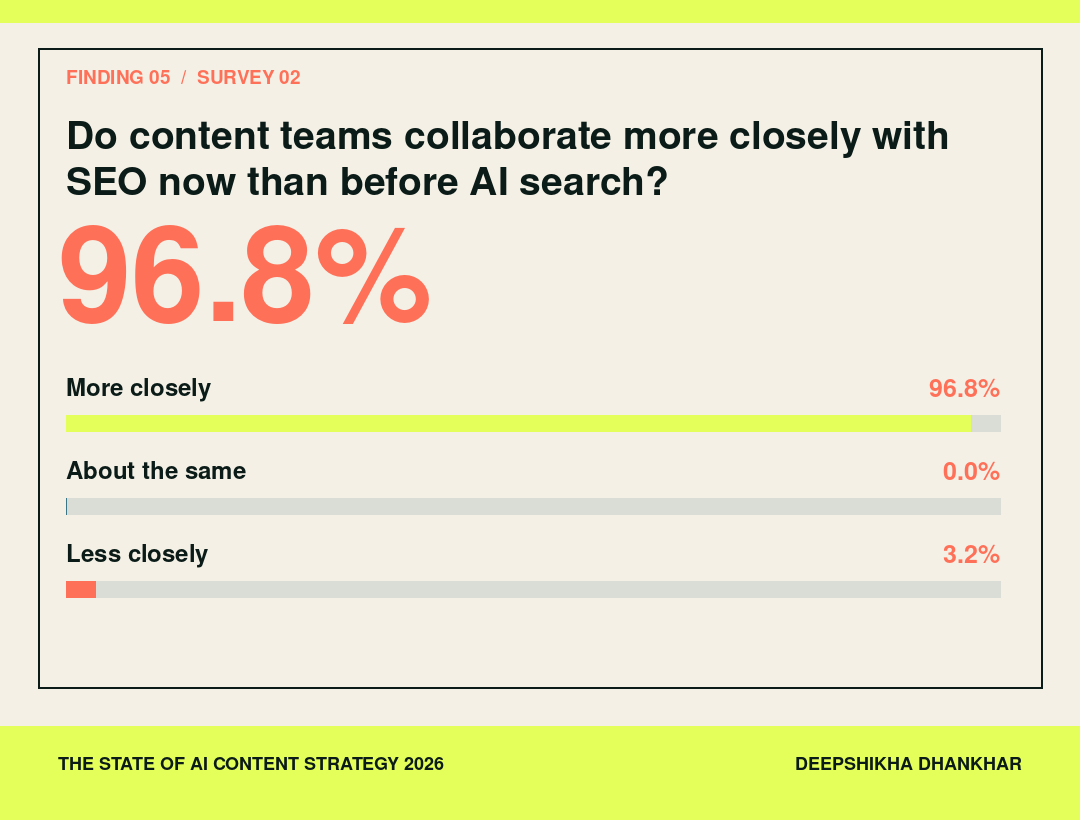
96.8% selected ‘More closely’, while 3.2% selected ‘Less closely’ and 0% selected ‘About the same’. The near-consensus indicates that AI search is already dissolving the operational boundary between the two functions. Teams need shared planning, briefs and measurement today; in future, content and SEO roles are likely to overlap more substantially around discovery and visibility.
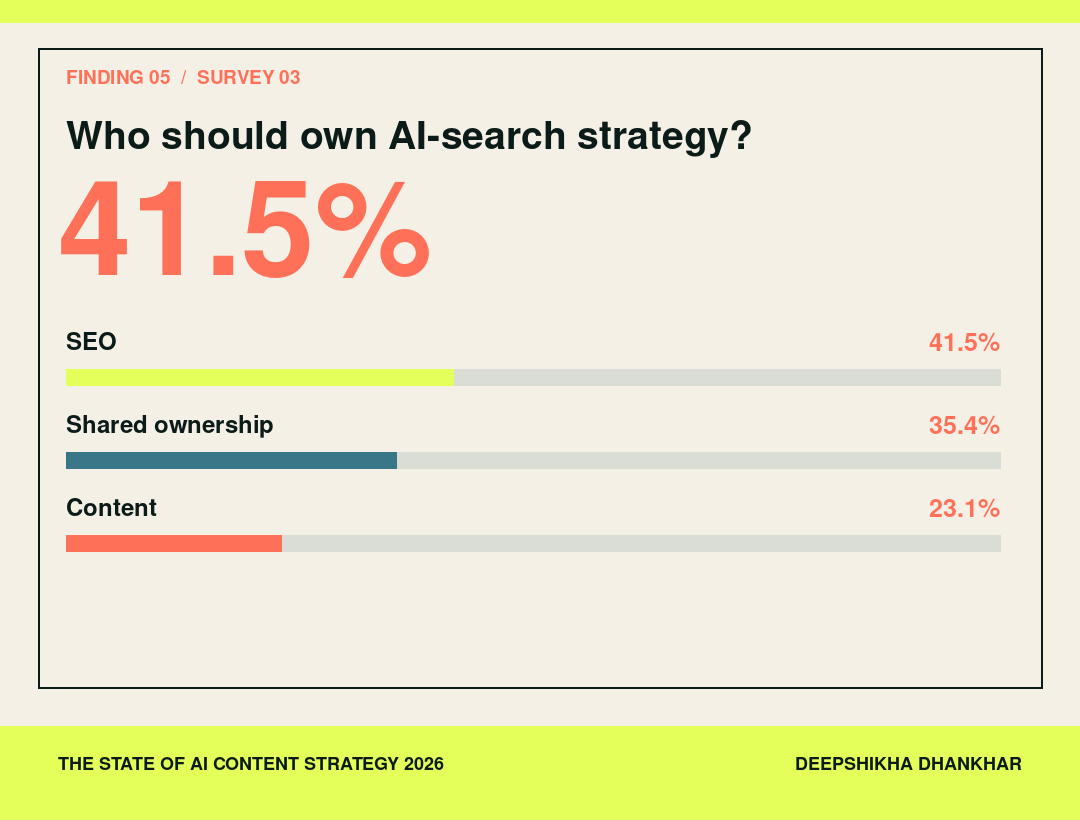
41.5% selected ‘SEO’, 35.4% selected ‘Shared ownership’ and 23.1% selected ‘Content’. No model commands a majority, so closer collaboration has not yet produced clear accountability. Teams need an explicit owner and decision process now; as AI search matures, durable governance will matter more than which function’s name sits on the work.
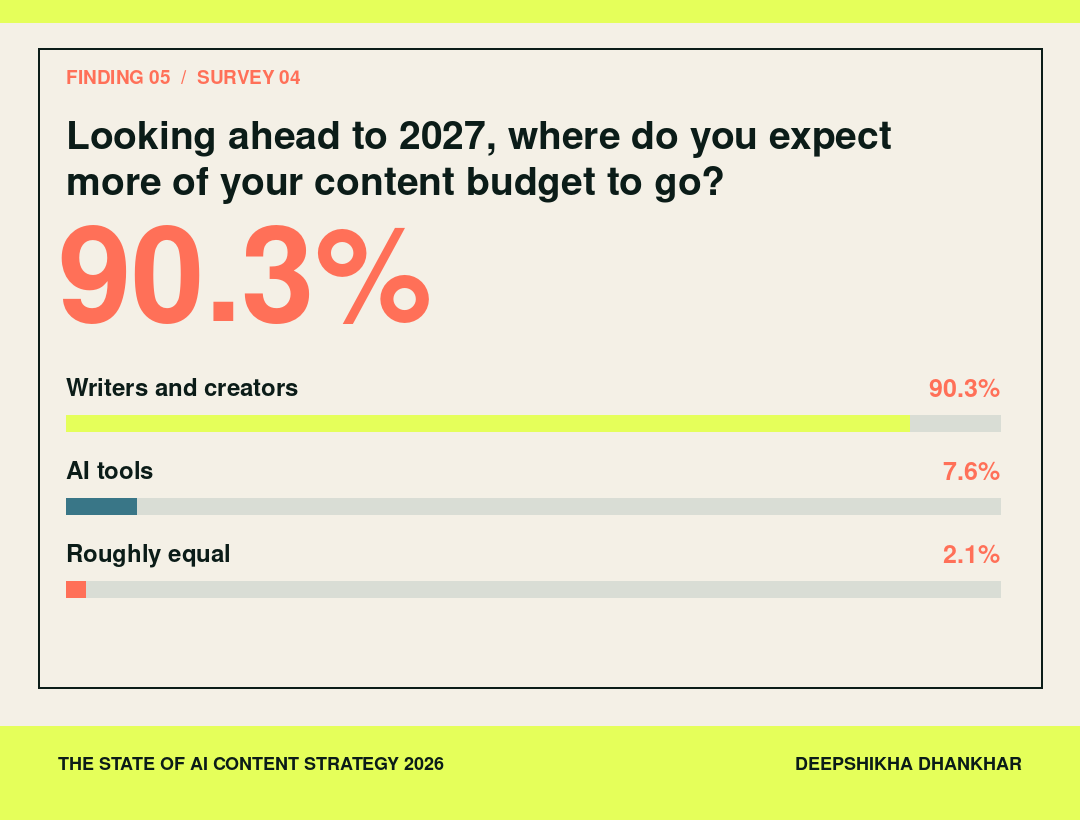
90.3% selected ‘Writers and creators’, compared with 7.6% who selected ‘AI tools’ and 2.1% who selected ‘Roughly equal’. The expected investment pattern positions AI as an augmentation layer rather than a near-term substitute for human creation. Teams should invest now in people who can use AI with judgement; future advantage is more likely to come from stronger expertise and evidence than from generating more content at lower cost.
47.7% selected ‘Not confident’, 36.9% selected ‘Somewhat confident’ and 15.4% selected ‘Very confident’. The 84.6% below the highest confidence level reveals a gap between expanding responsibility and technical understanding. Teams need practical LLM literacy now to evaluate recommendations and limitations; in future, that literacy is likely to become a core leadership competency across both content and SEO.
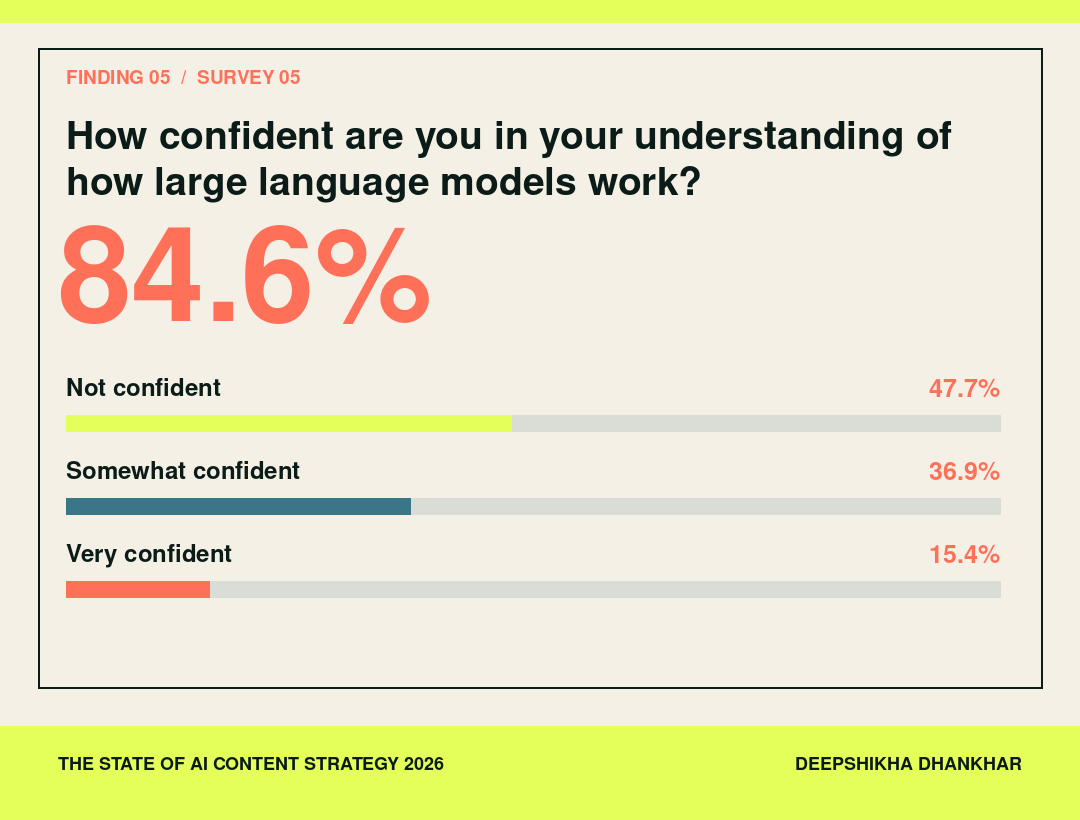
70.8% selected ‘One strategy for SEO and AI’, while 15.4% selected ‘Considering separation’ and 13.8% selected ‘Already separate’. Most leaders therefore see AI search as an extension of search and content strategy, not a parallel discipline. Teams need one planning system with channel-specific execution today; over time, measurement will need to connect rankings, traffic, citations and business outcomes within the same view.
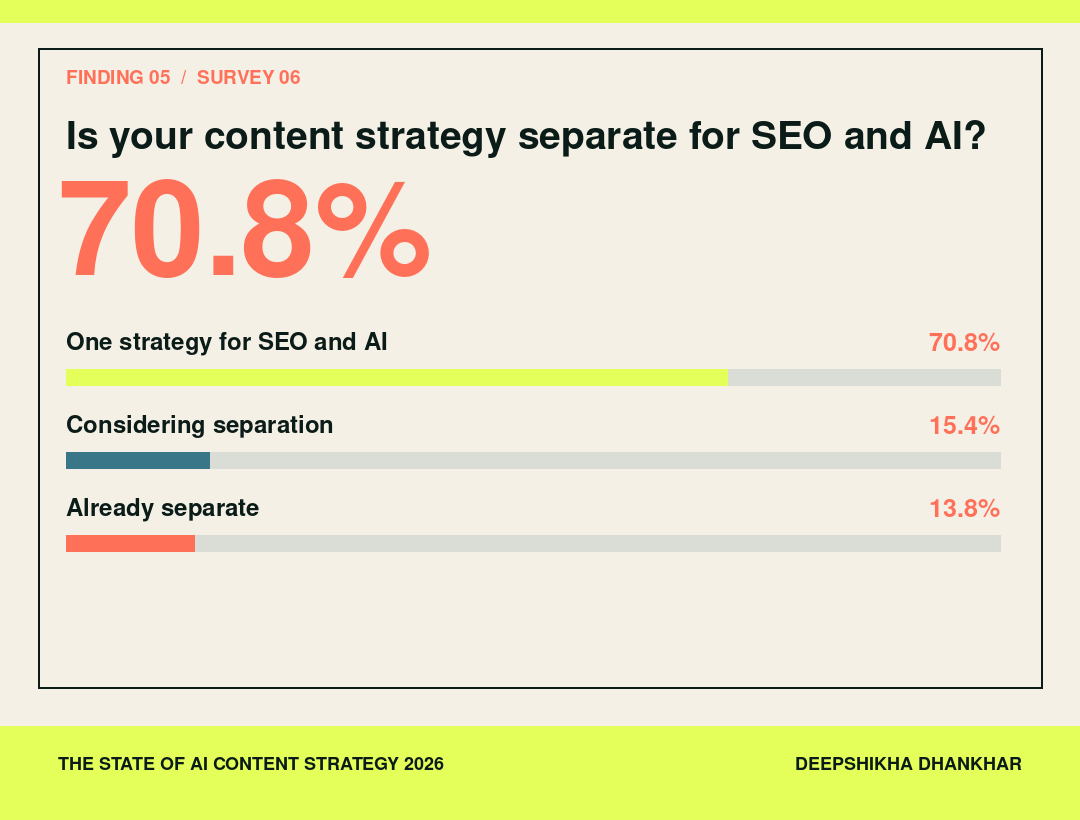
61.0% selected ‘Yes, for growth or AI opportunities’ and 38.0% selected ‘Yes, because of pressure, burnout, or uncertainty’; only 1.0% selected ‘Not looking for a change’. The combined 99% inclination towards movement makes role clarity, development and workload an immediate retention issue. If teams do not address both opportunity and strain, future AI capability may be constrained less by technology than by the loss of experienced people.
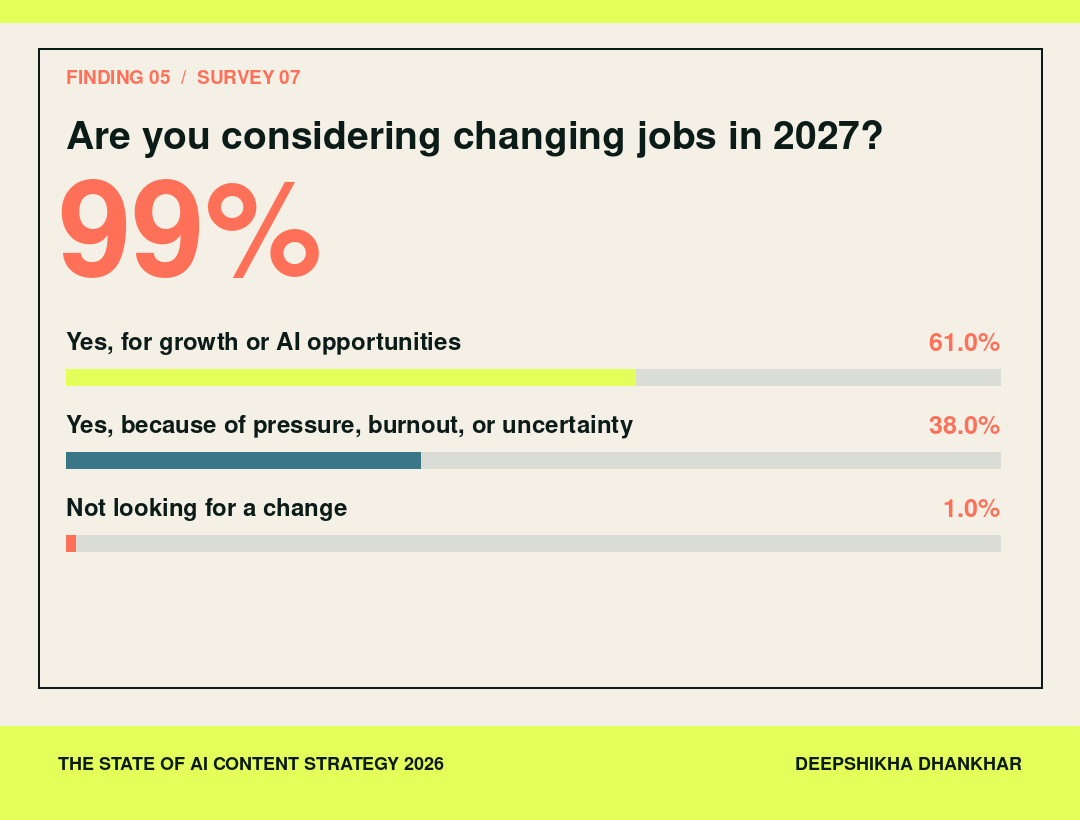
55.9% selected ‘It’s an acceptable trade off’, while 27.7% selected ‘We’re not willing to sacrifice SEO for GEO’ and 16.5% selected ‘We’re treating SEO and GEO as complementary’. The majority is willing to reconsider established performance priorities, but more than two in five are not prepared to accept a simple trade-off. Teams need guardrails and a combined scorecard now; future performance models will need to balance rankings and traffic with AI visibility, citations and downstream conversion.
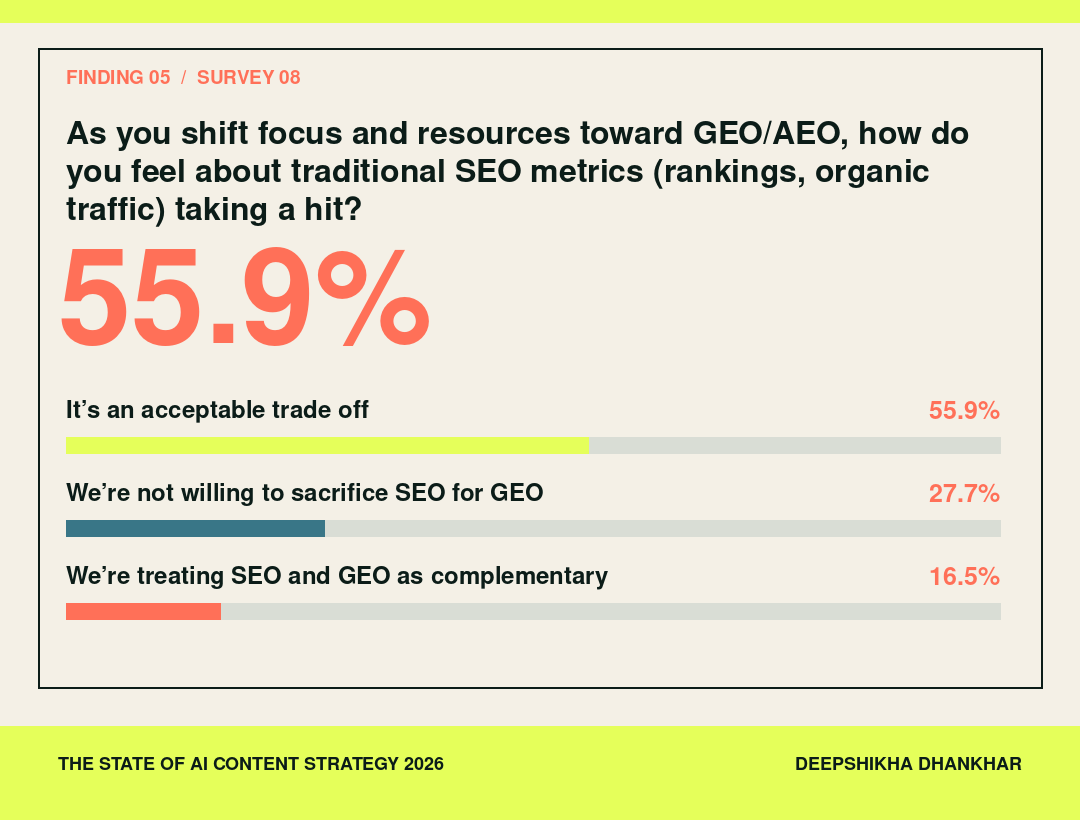
AI has expanded the content leader’s remit faster than it has expanded confidence.
Methodology
The report combines 36 coded source records with survey responses from 723 senior content leaders. Each finding is reported against its relevant denominator.
In September 2026, survey questions were fielded to Heads of Content and Content Strategy in the UK and US with a near-even geographical split and 10–15 years of professional experience. Survey findings in section 05 use 723 completed responses as their denominator.
The survey captures reported attitudes and expectations within a targeted senior content-leadership cohort. It does not observe organisational behaviour directly and should not be treated as representative of every content professional.
Thirty-six identifiable source records were coded across open-source frameworks, commercial products, practitioner discussions, company positioning and long-form strategy guides. Unless a finding explicitly names a smaller subset, percentages use these 36 records as the denominator.
More than 20,000 publicly available pages and discussions formed the broader Exa discovery pool. They helped surface potential material, but they were not individually coded. No percentage in this report uses 20,000+ as its denominator.
The 50% measurement finding represents 18 of 36 coded records. The 47% AI-search finding represents 17 of 36. The 91% execution-accelerator finding uses only the smaller subset of records that took an explicit position on AI’s role, so it should not be interpreted as 91% of the full corpus.
The research concentrates on content strategy, SEO, AI search, GEO, AEO, martech, B2B SaaS, content operations, agencies, consulting and AI content platforms.